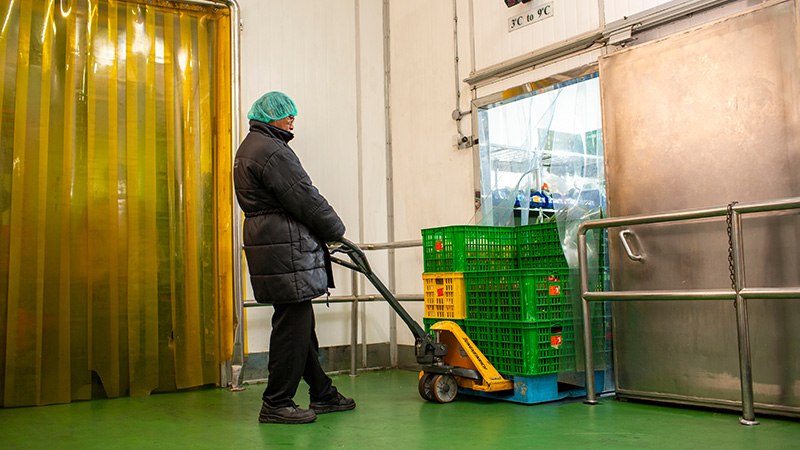
Anyone working in a cold storage warehouse, freezer room or frozen food warehouse knows that low temperatures are a constant part of the job all year round, often ranging from 0°C to -25°C. Cold stress is therefore not just a seasonal hazard, but an ongoing occupational risk across a wide range of industries, including food production, cold-chain logistics, construction and grounds maintenance.
Outdoor workers can also face extreme cold, with the highest-risk period typically from November through to March. In both indoor and outdoor environments, a cold workplace can have a significant impact on employees’ health and performance. As with heat, employers have a legal duty to identify and manage risks associated with thermal conditions in the workplace, including exposure to cold.
“Water dissipates heat up to 25 times faster than dry air.” — CCHST / INRS
In this article, you’ll find out what cold stress is, how to recognise the symptoms, what Belgian and Dutch legislation requires, how cold storage warehouses differ from freezer rooms, which preventive measures are most effective, and what to consider when selecting PPE for extreme cold.
Are you looking for practical tips on working outdoors in winter? Read Working outdoors in the cold? The following types of PPE will protect you from head to toe.
Sources: FPS Employment, Labour and Social Dialogue (Codex on Well-being at Work) | Arboportaal.nl (Health and Safety Decree) | Beswic – Exposure to Cold | CCHST | MSD Manual
In this article
- What is cold stress and when does it occur?
- Consequences and first aid
- Legislation: Belgium and the Netherlands
- Working in a cold storage warehouse or freezer room: what’s the difference?
- Organisational and technical measures
- PPE for extreme cold
- Checklist: 9 tips for a cold-resistant workplace
- Frequently Asked Questions
1. What is cold stress and when does it occur?
Cold stress is the physical strain that occurs when the body is unable to produce or retain sufficient heat to maintain its core temperature. Normally, this is around 37°C. Even a drop of 0.5°C can disrupt bodily functions. When the core temperature falls below 35°C, we refer to hypothermia, a condition that can ultimately lead to cardiac arrest.
Causes: more than just low temperatures
- Working in cold storage warehouses and freezer rooms, often at temperatures between 0°C and ‑25°C
- Low outdoor temperatures, especially when combined with wind (wind chill)
- Moisture and rain, which reduce the insulating properties of clothing
- Draughts and air flow in the workplace, for example from refrigeration systems and open doors.
Moisture plays a greater role than is often realised: wet clothing or wet skin dissipates heat much more quickly than dry clothing or dry skin. Two workplaces with the same temperature can present very different levels of risk. When conducting a risk assessment, it is essential to consider humidity, wind or air flow, duration of exposure, and the intensity of the physical activity.
Individual characteristics such as age, physical fitness, blood circulation, and pre-existing conditions like Raynaud’s phenomenon, must also be taken into account. Work-related factors, including sedentary tasks, wet clothing, and inadequately insulated PPE, can further increase the risk.
Who is most at risk?
Within each sector, certain employees may be more vulnerable to temperature-related risks. These include older and very young workers, individuals with cardiovascular or respiratory conditions or circulatory disorders, employees taking certain medication, and pregnant employees, who may also be entitled to specific protective measures under applicable regulations. Discuss the appropriate adjustments with the occupational health and safety adviser (Belgium) or the company doctor (the Netherlands), to include perhaps: reducing exposure, providing additional breaks, temporarily reassigning employees to alternative tasks, or adjusting working hours.
| Agri-food | Cold storage warehouses, freezer rooms, and meat and fish processing plants |
| Construction | Outdoor work on construction sites and roadworks during winter conditions |
| Cold-chain logistics | Refrigerated transport, and order picking in refrigerated warehouses |
| Forestry and landscape maintenance | Outdoor work in cold weather conditions |
| Fisheries and aquaculture | Exposure to cold and damp conditions, which can place high demands on the body |
2. Consequences of cold stress and first aid
Low temperatures are more than just a matter of comfort. When exposed to cold, the body activates two main defence mechanisms: it constricts blood vessels in the hands, feet, ears and nose (vasoconstriction) and it generates additional heat through shivering (thermogenesis). These responses require energy and can become physically exhausting over time. When these mechanisms are no longer sufficient to maintain body temperature, the skin temperature begins to fall, followed by the body's core temperature.
From discomfort to a medical emergency
Cold hands, feet or a cold face are among the first warning signs of cold stress. A more serious condition is mild hypothermia, in which the core body temperature drops to between 32°C and 35°C: shivering, slow or uncoordinated movements, confusion and fatigue. Immediate action is essential if hypothermia is suspected.
A further drop in core body temperature below 32°C increases the risk of serious complications such as loss of consciousness, while temperatures below 28°C can lead to life-threatening cardiac arrhythmias and cardiac arrest. According to the MSD Manual, severe hypothermia, particularly at core temperatures below 28°C, is associated with a mortality rate of approximately 20–50%.
Localised frostbite mainly affects the fingers, toes, nose and ears and can lead to irreversible tissue damage. Raynaud’s phenomenon can also be triggered by the cold: the fingers suddenly turn white and then blue, often accompanied by pain or a tingling sensation.
Hidden risks
Low temperatures impair concentration, weaken grip strength, slow down reaction times and reduce fine motor control. Muscles become stiffer and fatigue more quickly, while wet or icy surfaces increase the risk of slips and falls. These effects significantly increase the risk of workplace accidents, even when cold exposure is not immediately recognised as the underlying cause. Repeated or prolonged exposure to cold, such as daily work in a cold storage warehouse, can also lead to long-term cold-related injuries affecting the hands and feet.
3. Legislation on cold and thermal stress
| Belgium: Codex on Well-being at Work — Book V, Title 1: Thermal environmental factors | The Netherlands: Article 6.1 of the Working Conditions Decree (Arbobesluit) |
|---|---|
| Mandatory risk assessment of all thermal environmental factors, covering both cold and heat. | Workplace temperatures, as well as the temperature of products being handled or processed, must not pose a risk to employees’ health. |
| The analysis covers: Temperature, humidity, airflow velocity, thermal radiation, physical workload, working methods, clothing and PPE. | There is no statutory minimum workplace temperature. However, employers are required to take all reasonably necessary measures to prevent adverse health effects |
| Where applicable cold-exposure action limits are exceeded, employers must establish a programme of technical and organisational preventive measures. | If cold exposure continues to pose a risk, the employer must provide appropriate personal protective equipment (PPE) free of charge, such as warm clothing and gloves. In practice, 15°C is often used as a guideline, but this threshold is not established as a general statutory minimum temperature. |
| Under Articles V.1-5 to V.1-13, preventive measures may include alternating periods of work and rest, adapting workstations, and providing suitable PPE. | In certain sectors, such as construction and landscaping, collective agreements or occupational health and safety guidelines may require work to stop when the wind chill falls below −6°C, due to what is commonly referred to as unworkable weather. This is not a legal limit |
Sources: FPS Employment – Thermal environmental factors | Arboportaal.nl – What does the law say about working in cold conditions?
Neither Belgian nor Dutch legislation distinguishes between outdoor work and work in cold indoor environments: cold storage warehouses and freezer rooms are explicitly subject to the same obligations as working outdoors in wintry temperatures.
What does this actually mean for your organisation?
- Identifying and documenting risks. Include cold exposure in your risk assessment in Belgium or your Risk Inventory and Evaluation (RI&E) in the Netherlands. Identify the jobs most at risk, the factors that may increase exposure, and the employees who are most vulnerable.
- Provide heated facilities. Employees must be able to warm up regularly. Provide a heated break room, access to hot drinks, and suitable facilities for drying wet clothing.
- Organise work differently. Schedule tasks during the most favourable conditions, limit continuous exposure to cold, and introduce shifts where appropriate. Whenever possible, postpone outdoor work during adverse weather conditions.
- Provide suitable PPE. Select PPE according to the temperature, wind, humidity, and duration of exposure. Ensure that it provides adequate protection while maintaining comfort and freedom of movement.
- Provide information, training and preparing for emergencies. Ensure that employees can recognise the early signs of hypothermia and frostbite. All staff should be familiar with the emergency procedures.
4. Working in a cold storage warehouse or freezer room: what’s the difference?
The same legal obligations apply to cold storage warehouses and freezer rooms as to outdoor work, but the risks differ. Rather than being driven by weather conditions and seasonal changes, the main challenges are prolonged exposure to low temperatures, frequent and rapid temperature changes, and the need to maintain both safety and hygiene standards.
How does this differ from outdoor work?
- Temperature fluctuations. During a single shift, order pickers may repeatedly move between a warm dispatch area, a cold storage warehouse and a freezer room. Employees who sweat during physical activity may find their clothing becomes damp, increasing heat loss when they move into colder environments. Provide a designated transition area and encourage employees to wear layered clothing that can be easily unfastened or removed as temperatures change.
- Airflow. Refrigeration systems can direct cold air towards workstations, while open doors may create additional draughts. These increase convective heat loss and intensify the cooling effect, much like wind outdoors. So don’t assess temperature alone. Also consider air velocity at the workstation.
- Contact dermatitis. Metal racks, frames and tools can become extremely cold, and direct contact with bare skin may cause the skin to freeze to the surface. Choose suitable protective gloves that offer adequate insulation against contact cold (the second digit of the EN 511 marking).
- Stationary work. Forklift drivers and assembly-line workers generate little body heat, making them more susceptible to cooling than employees who are physically active. Where possible, provide heated vehicle cabins or suitable heated clothing.
- Ice and condensation. At entrances to cold-storage warehouses and loading bays, ice and condensation can increase the risk of slips and falls. Inspect and clearly mark these areas with a floorstand ‘slippery floor’, and provide suitable safety footwear with effective slip-resistant soles (SRC).
- Working alone. Employees working alone in a cold storage warehouse or freezer room must always be able to raise the alarm and obtain assistance in an emergency. Ensure that every cold storage facility can be opened from the inside, provide an emergency call system, and keep track of employees working alone.
How long are you allowed to work in cold conditions?
There is no universal maximum duration for working in cold conditions. The time a person can work safely in cold conditions depends on several factors, including temperature, airflow, physical workload and the protective clothing worn. These factors should be assessed as part of the workplace risk assessment. Organise work in order to balance exposure periods with regular warm-up breaks in a heated room, and seek advice from the occupational health and safety adviser in Belgium or the company doctor in the Netherlands. To assess cold-related risks in the workplace, consult the following standards: ISO 15743 (risk assessment and management of cold workplaces) and EN ISO 11079 (IREQ method for the required insulation of clothing).
5. Organisational and technical measures
PPE alone cannot eliminate the risks that a well-organised and appropriately equipped working environment can. The first line of defence against cold stress should be a combination of organisational and technical measures.
Organisational measures
- Extra and more frequent breaks in a heated area with sufficient time to rest and warm up
- Limited exposure time in cold environments, such as cold storage warehouses
- Use job rotation systems and task-sharing to prevent employees from being continuously exposed to cold conditions
- Supply hot drinks in easily accessible places
- When working outdoors: Schedule tasks during the warmest parts of the day, postpone non-urgent activities where possible, and monitor weather forecasts and official warnings issued by the KMI (Belgium) or KNMI (the Netherlands).
- Gradually increase exposure for new employees
- Ensure regular awareness-raising and training for staff and managers
Technical measures
- Minimise draughts and cold air currents, for example by using door strips or air curtains in cold storage warehouses and by directing cold air currents away from workstations
- Install transition zones or airlocks to provide an intermediate space between warm and cold areas where employees can adjust gradually to temperature changes. This also helps reduce the amount of warm, humid air entering cold storage areas.
- Heat or insulate workspaces where technically possible and feasible
- Windbreaks for outdoor work
- Provide resources to reduce physical strain when carrying out tasks requiring employees to remain stationary for extended periods in cold conditions
- A heated break room and drying facilities for wet clothing, gloves and boots, such as a drying panel with 20 hangers or a Biotech AR60 drying and disinfection cabinet
6. PPE for extreme cold conditions
Technical and organisational measures provide the foundation for preventing cold stress, while PPE can help employees work safely in cold conditions for longer. Effective PPE should not just provide protection against the cold. It should allow freedom of movement, minimise perspiration and be compatible with other protective equipment required for the job. The following section explores the additional protective measures required when working in extreme cold conditions. Looking for the right clothing and accessories to work safely outdoors in winter? Find more options and practical advice in our PPE guide for outdoor work.
The standards at a glance
| Standard | Application | Characteristics |
|---|---|---|
| EN 14058 | Cold environments (≥ -5°C) | Protection against moderate cold environments. Particularly suitable for employees alternating between indoor and outdoor work. |
| EN 342 | Extreme cold (< -5°C) | Enhanced thermal insulation for cold storage facilities, freezer rooms and severe frost. |
| EN 343 / EN ISO 24232:2025 | Weather conditions | Protection against rain, snow and wind (particularly relevant when working outdoors) |
| EN 511 | Gloves | Protection against convective cold, contact cold and damp |
| EN ISO 20345 CI | Safety footwear | Insulation of the sole to minimise heat loss through the feet |
Clothing for extreme cold (EN 342)
In extremely cold conditions, an ordinary winter coat may not provide sufficient protection. The layered clothing system remains the basic principle (thermal base layer, insulating middle layer and protective outer layer), but the outer layer here complies with EN 342. Check the garment label for its thermal insulation value (Icler) and air permeability. These properties should be appropriate for the temperature, airflow and intensity of the physical activity. Employees who move around a lot in cold storage warehouses may benefit from clothing that can be quickly opened to prevent excessive perspiration. For a detailed explanation of how the layered clothing system works and which materials are best suited to each layer, see The 3-layer system: what are the 3 layers and how do you combine them?.
Hands, feet and head
- Hands: choose gloves in compliance with EN 511 that offer good protection against contact cold. For precision work, combine a thin, finger-sensitive inner glove with an insulated outer glove.
- Feet: lined work boots, a cold-insulating sole (CI) and woollen socks minimise heat loss. You should also choose footwear that is waterproof and non-slip, as condensation and ice are never far away.
- Head and face: helmet liners, winter caps and a neck warmer keep your head and neck warm without affecting the fit of your helmet. In strong draughts, it is also advisable to wear face protection.
- Extra warmth: warming packs and heated clothing, such as the ultrasonic-heated tunnel jacket or heated body warmer, are particularly useful for long periods of stationary work, for example for forklift truck drivers.
Combine cold protection with other PPE requirements
Protective clothing designed for cold conditions must not compromise the effectiveness of any other PPE required for the job. Do you work in low-light conditions or alongside roads? In that case, choose high-visibility clothing with reflective strips that complies with EN ISO 20471. Do you wear a safety helmet when you’re working? Opt for a removable thermal lining or compatible helmet liner without compromising the helmet's fit. Do you work with chemical products? Check that the materials used are compatible. Do you work in the food industry? Cold-weather clothing must also meet applicable hygiene requirements. It should be washable, free from loose or detachable components and compatible with hairnets and beard nets. And when carrying out precision work, always check that your gloves retain sufficient grip and sensitivity.
Make sure that PPE is actually worn
Even the best protective equipment is ineffective if employees do not wear it. The following list outlines common objections and practical solutions:
| Objection | Solution |
|---|---|
| The clothing is too bulky | Choose ergonomic designs that allow freedom of movement |
| Gloves reduce precision | Match the level of insulation to the tasks required |
| I sweat when I’m physically active | Choose breathable base layers and use the three-layer clothing system |
| The footwear is uncomfortable | Select a suitable model that matches the activity and weather conditions |
Involve employees in the selection process, organise practical trials and gather feedback. PPE should also be inspected regularly: A worn-out jacket, damaged gloves or safety boots with compromised thermal insulation may no longer offer adequate protection against the cold.
Checklist: 9 tips for a cold-resistant workplace
- Risk analysis (Belgium) or RI&E (Netherlands) updated to include cold conditions, including wind, humidity and duration of exposure
- Weather conditions and weather warnings from KMI/KNMI throughout the winter months (November–March). Monitor temperatures in cold storage warehouses and freezer rooms throughout the year.
- Availability of heated break room and drying room or drying system
- Work schedules, rotas and warm-up times can be adjusted in cold weather
- Thermal PPE has been purchased, distributed and regularly inspected to ensure it remains in good condition
- Emergency procedures drawn up and displayed in a clearly visible location (112); cold rooms can be opened from the inside, an emergency call system is in place and lone workers are monitored
- Staff and managers are trained to recognise the warning signs of hypothermia and frostbite
- Vulnerable staff have been identified and measures agreed with the occupational health practitioner or company doctor
- There are records of all measures implemented, which can be reviewed and verified.
Frequently asked questions about working in extreme cold
What is cold stress?
Cold stress is the physical strain that occurs when the body is unable to produce or retain sufficient heat to maintain its core temperature of approximately 37°C. Wind, damp conditions, stationary work and inadequately insulated clothing can all increase the effects of cold exposure.
At what temperature is working in the cold no longer permitted?
There is no fixed statutory minimum temperature. In the Netherlands, workplace temperatures must not pose a risk to employees’ health. The employer must provide suitable protective equipment free of charge. A temperature of 15°C is sometimes used as a practical guideline, but it is not a statutory minimum. In some sectors, including construction, collective labour agreements or health and safety guidelines may specify that work must stop when the perceived temperature (wind chill) falls below −6°C. In Belgium, action values for exposure to cold apply based on a mandatory risk assessment.
Do cold storage warehouses and freezer rooms fall under the same regulations as outdoor work?
Yes. Neither Belgian nor Dutch legislation makes a distinction between outdoor work and work in cold indoor environments.
What are the warning signs of hypothermia?
Severe shivering, unusual tiredness, difficulty speaking, confusion or disorientation, and drowsiness. Hypothermia occurs when the body's core temperature falls below 35°C.
What should you do if someone develops hypothermia at work?
Call 112, move the person out of the cold and away from the wind, remove any wet clothing, and gradually wrap them in dry clothing or a thermal emergency blanket. Offer a warm drink only if they are fully conscious and able to swallow safely. Never attempt to warm frozen body parts abruptly.
How long are you allowed to work in a cold storage warehouse or freezer room?
There is no universal maximum working time. The permitted exposure time should be determined through the workplace risk assessment and depends on factors such as the temperature, airflow, physical demands of the work and protective clothing worn. Alternate periods of work in the cold with warm-up breaks in a heated area. Consult your health and safety adviser, occupational health professional or company doctor.
What PPE do you need in extreme cold conditions?
In extreme cold conditions (below -5°C), choose protective clothing that complies with EN 342. Supplement this with gloves that comply with EN 511 and that provide suitable protection against contact cold. Wear safety footwear with a cold-insulating sole (CI) and a suitable helmet liner or neck warmer. Wear these in layers and check that all PPE is compatible with other protective equipment and complies with workplace hygiene requirements. Are you looking for clothing for working outdoors in cold conditions? Here you’ll find more practical tips for working safely outdoors in winter.
Summary
- Include cold exposure in your risk assessment and review it regularly.
- Organise work to minimise exposure and ensure employees have access to a heated area for warm-up breaks.
- Consider the specific risks associated with cold storage warehouses and freezer rooms, including: temperature fluctuations, airflow, contact chill, ice formation and people working alone.
- Select PPE suitable for extreme cold and ensure it meets the specific requirements of each role, such as hygiene requirements.
- Train employees to recognise the early signs of hypothermia and frostbite and practise how to respond appropriately.
- Pay particular attention to vulnerable staff members.
Cold stress requires a tailored approach. The right combination of preventive measures and PPE depends on your sector, working environment and specific risk profile — whether your employees work in a cold storage warehouse, a freezer room or outdoors in severe winter conditions. Our Safety Experts will be happy to help you find the right solution for your needs.