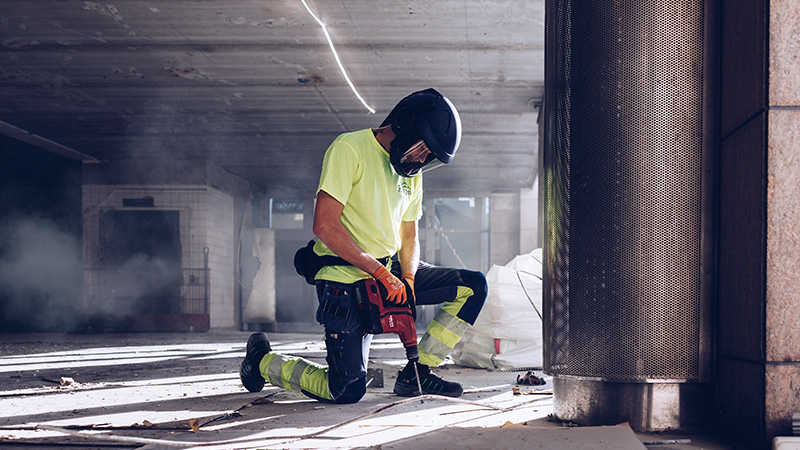
Source: Sundström
Anyone who works with concrete or brick on a daily basis is exposed to respirable crystalline silica—commonly known as quartz dust. Quartz dust is a proven cause of lung cancer, but the danger is still often underestimated. The damage to the lungs is irreversible, and may only become apparent after ten to twenty years.
Since 1 September 2025, stricter exposure limits for quartz dust have been in force in Belgium, and stricter exposure limits are being prepared for the Netherlands. Because the legal limit is lower than it used to be, you will exceed that limit more quickly when exposed to the same amount of dust, meaning you will also need to switch to more robust respiratory protection sooner. A standard dust mask (FFP3) is therefore often insufficient: at least a half-mask or full-face respirator with a P3 filter is now frequently required.
However, this is only suitable for short-term work and only when the mask fits the face perfectly. This tightening applies specifically to the exposure limit for quartz dust, not to hazardous substances in general.
In this article, you'll learn what the updated legislation requires, and how to effectively protect your workforce.
In brief
- Quartz dust exposure limit in Belgium: 0.05 mg/m³ since 1 September 2025 (previously 0.1 mg/m³)
- Quartz dust exposure limit in the Netherlands: 0.075 mg/m³ (8-hour working day)
- IARC classification: Group 1 – proven carcinogenic to humans
- Minimum respiratory protection: Half-mask or full-face mask respirator with a P3 filter; FFP2/FFP3 disposable masks are not sufficient
What are the risks of quartz dust?
Quartz is a mineral that occurs naturally in rocks, sand and clay, and is therefore also found in everyday construction materials such as bricks, concrete, plasterboard, asphalt and cement. When these materials are processed (cut, drilled, ground or blasted), microscopic dust particles are released that can penetrate deep into the lungs. These particles are known as respirable crystalline silica, or, simply: quartz dust.
Once inhaled, the lung tissue responds by forming scar tissue around the dust particles. This process causes chronic inflammation, which, over time, can damage the DNA in lung cells, increasing the risk of lung cancer. The latency period between exposure and the onset of disease can be as long as ten to twenty years, meaning the risk can remain invisible for many years.
The International Agency for Research on Cancer (IARC) classifies quartz dust as a Group 1 carcinogen: a proven cause of cancer in humans. Lung damage caused by quartz dust is also irreversible. Once the lung tissue has been damaged, it does not recover.
Who is at risk in the workplace?
Quartz dust, or respirable crystalline silica, is not a niche problem. It is a widespread occupational hazard across a wide range of sectors and occupations: tilers, bricklayers, concrete workers, demolition workers, as well as employees in the ceramics industry, in the production of concrete blocks, or professionals involved in sandblasting operations. Even shovelling dry materials containing silica can generate enough dust to pose a risk.
What many people don’t realise is that, once quartz dust has settled, it can easily become airborne again through vehicle movements, site traffic, sweeping, or even strong winds. As a result, colleagues who do not work directly with this material can also be exposed. Quartz dust is a risk across the entire construction site, not just for those cutting concrete.
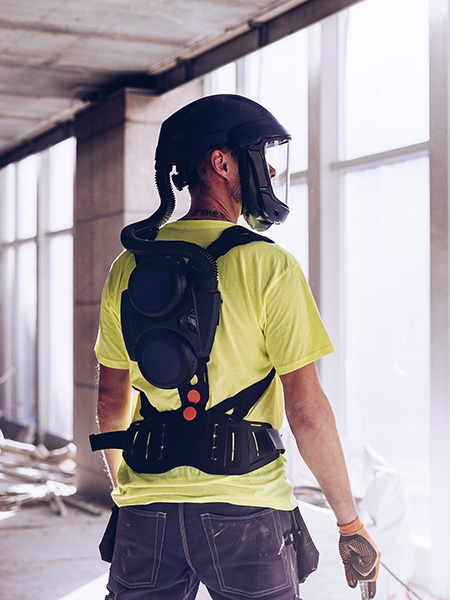 Source: Sundström
What does the law say? Regulations in Belgium and the Netherlands
In recent years, both Belgium and the Netherlands have tightened their regulations regarding occupational exposure to respirable crystalline silica, following updated European legislation and growing scientific evidence on its health risks.
Belgium has had regulations governing exposure to quartz dust for many years, but these became stricter on 1 September 2025. In the past, an employee could be exposed to a maximum of 0.1 mg/m³ of quartz dust per working day. Since then, the limit has been reduced to 0.05 mg/m³ — just half the previous limit. In practical terms, this means that with the same amount of dust on a construction site, you are now more likely to exceed the legal limit than before and therefore need to take action sooner by providing more robust respiratory protection. A standard FFP2 or FFP3 dust mask filters less efficiently than a half-mask or full-face respirator with a P3 filter and, at this lower exposure limit, often does not provide sufficient protection.
The legal basis is the Code on Well-being at Work (Book VI). Quartz dust is listed there as a carcinogenic substance, which creates three additional obligations for employers, to:
- Maintain a register of employees exposed to quartz dust;
- Provide justification for why quartz has not yet been replaced by a safer alternative;
- Keep a record of the protective measures that have been implemented.
The Belgian Federal Public Service Employment (FPS Employment) actively monitors whether companies comply with these regulations. (Source: mediwet.be)
The Netherlands applies an exposure limit of 0.075 mg/m³ for an eight-hour working day, with quartz dust likewise classified as a carcinogenic substance. The legal basis is set out in the Working Conditions Act (Arbowet). The Netherlands Labour Inspectorate considers visible dust in the breathing zone to be evidence of a violation, with fines of up to €27,000. (Source: Occupational Health and Safety (Arbotechniek), Netherlands Labour Authority (Nederlandse Arbeidsinspectie))
| Belgium | The Netherlands | |
|---|---|---|
| Exposure limit | 0,05 mg/m³ | 0,075 mg/m³ |
| Legal basis | Code on Wellbeing at Work | Health and Safety at Work Act + Working Conditions Decree |
| Enforcement | FPS Employment [FOD Werkgelegenheid] | Netherlands Labour Authority [Nederlandse Arbeidsinspectie] |
By way of comparison: in Belgium, the exposure limit was 0.1 mg/m³ until 1 September 2025 – double the current limit.
One principle applies in both countries: common activities such as drilling or grinding can exceed the exposure limit by tens or even hundreds of times without additional control measures. Respiratory protection is not optional—it is a legal requirement.
How can you work safely with quartz dust? The statutory step-by-step approach
Both the Belgian Code on Well-being at Work and the Dutch Working Conditions Act (Arbowet) establish a clear hierarchy of prevention: first eliminate the risk at source, and only use personal protective equipment as a last resort.
STEP 0: MEASURE THE EXPOSURE
Before taking any measures, you need to know the extent of the problem. Engage an occupational health and safety adviser through your external service for prevention and protection at work (EDPBW). The health and safety advisers will objectively determine whether the current situation exceeds the exposure limit and where adjustments are needed. Repeat these measurements regularly, especially after changes to working method or materials, and actively investigate whether employees report breathing difficulties or other symptoms. Early warning signs should never be ignored.
STEP 1: SOURCE CONTROL MEASURES
The most effective measure: eliminate the problem at source. During the design phase, choose materials that contain no or less quartz. Use working methods that eliminate the need to process quartz-containing materials wherever possible. Source control measures are the most effective as they eliminate the risk for everyone in the workplace, not just for the individual wearing a mask. This also applies to any future processing or handling.
STEP 2: ORGANISATIONAL MEASURES
Establish clearly defined ‘clean’ and ‘dirty’ zones. Limit the number of employees in a risk zone. Provide targeted information and training—not as a one-off formality, but as a recurring topic during toolbox meetings and employee induction.
STEP 3: TECHNICAL MEASURES
This is where significant improvements can be achieved through effective interventions. Use industrial vacuum systems rather than sweeping. Apply wet working methods wherever possible. Prohibit or strictly limit the use of compressed air for cleaning. Achieve the highest level of dust control by combining local exhaust ventilation (LEV) with water suppression. Consider using fine dust sensors in the work area or personal monitoring sensors attached to clothing or helmets. Visible monitoring can significantly increase employees’ awareness.
STEP 4: PERSONAL PROTECTIVE EQUIPMENT
Personal protective equipment (PPE) should only be used when the previous steps are insufficient to keep exposure below the limit.
Additional considerations for a safe workplace
- Combine control measures. No single control measure works optimally on its own. Combining wet working with local exhaust ventilation provides a much greater reduction in exposure than either measure alone. The same applies to combining technical measures with the appropriate respiratory protection.
- Don’t forget about indirect exposure. Clean the work areas regularly, using the appropriate methods: vacuum rather than sweep. Make sure that maintenance personnel and other workers in the vicinity are also protected, not just the operator working at the machine.
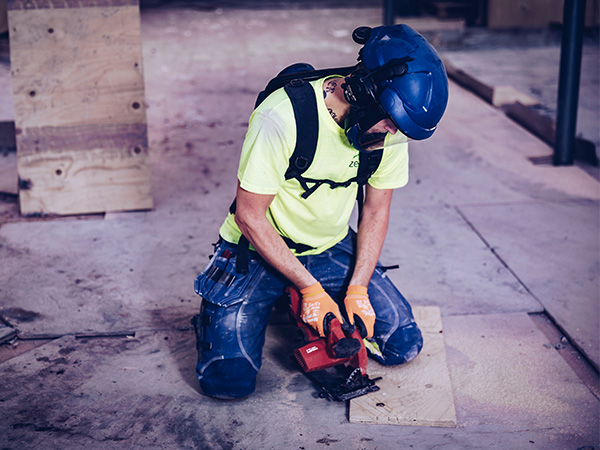 Source: Sundström
What respiratory protection is required for quartz dust?
With an exposure limit of 0.05 mg/m³ in Belgium and 0.075 mg/m³ in the Netherlands, a standard FFP3 dust mask is no longer sufficient in most cases. Specifically:
- For work where dust extraction or wet working methods are insufficient, at least a half-mask or full-face mask with a P3 filter is required.
- In cases of intensive exposure, a powered air-purifying respirator (PAPR) with a P filter, such as a powered air hood or full-face respirator, is recommended.
- Appropriate training on the correct use, fit and maintenance of the protective equipment is legally required and essential for its effectiveness.
The administrative obligations – maintaining a register, providing justification, and keeping an overview of the measures taken – are explained above in the section on Belgian regulations.
Maintenance: an essential part of protection
Whatever respiratory protection you choose, proper maintenance is an essential part of effective protection. Even the highest-performing and most comfortable equipment will provide insufficient protection if it is not maintained correctly. Make sure to clean the equipment in good time, replace the filters and check regularly for wear and tear or damage. You can always contact our experts for advice on these matters.
Respiratory protection for quartz dust: which solution is right for your situation?
An important, yet difficult, choice
With the recent tightening of exposure limits—and further tightening expected in the future—choosing the right respiratory protection has become more important than ever, but also more challenging. Avoid purchasing equipment that meets the requirements today but may already prove insufficient tomorrow. The wrong investment can prove unnecessarily costly, not to mention the personal risks associated with choosing the wrong equipment.
For quartz dust, an FFP3 disposable mask is no longer sufficient. The choice comes down to four solutions:
| Half-face respirator with P3 filter | Full-face respirator with a P3 filter | Powered air-purifying respirator (PAPR) with hood | Powered air-purifying respirator (PAPR) with full-face mask | |
|---|---|---|---|---|
| Comfort | Moderate: tiring and hot during prolonged use—therefore not recommended for extended periods. | Moderate: tiring and hot during prolonged use—therefore not recommended for extended periods. | Good: comfortable for prolonged use, with positive pressure airflow inside the hood. |
Fairly good: airflow provides greater comfort than a mask without powered assistance. PLEASE NOTE: Face fit testing remains essential. |
| Breathing resistance | High: active effort is required with every breath | High: active effort is required with every breath | None: the powered fan does the work | Reduced by the airflow |
| Beard | Must be clean-shaven | Must be clean-shaven | Beards allowed | Must be clean-shaven |
| Glasses | Not possible to wear with glasses | Personal prescription glasses cannot be used | Personal prescription glasses can be worn with the powered air hood | Not possible to wear with glasses |
| Eye protection | Not included | Included | Included (with a powered air hood) | Depending on the type of mask |
| NPF | 50 | 1000 | 10–500 | 2000 |
| Best suited for | Lower concentrations of quartz dust | High concentrations of quartz dust | Prolonged period of use, glasses wearers, or workers with beards | Very high concentrations, where the highest level of protection is required |
More and more construction firms are switching to powered respiratory protection systems, and at Vandeputte we are seeing a clear increase in demand for them. The principle is simple but effective: a built-in powered fan continuously supplies filtered air to the user, so breathing no longer requires physical effort.
What this means in practice:
- No breathing resistance: the motor does the work, not your employee’s lungs. Wearing this system for a full working day feels much easier than wearing a conventional mask, even during intensive work.
- Greater comfort: less condensation on the visor, less heat build-up, and fewer pressure points on the face. Employees are more likely to wear protective equipment if they find it comfortable.
- Multiple PPE types in a single product: a powered system combined with a helmet integrates respiratory, head, eye, face and hearing protection in a single unit. This means fewer separate pieces of protective equipment to combine, manage and replace, and a fit that is designed as a complete system rather than assembled from separate components.
Are you looking for advice on choosing the right respirator? Our experts are happy to help you find a solution that suits your working environment and team.
Frequently asked questions about quartz dust
WHAT RESPIRATORY PROTECTION IS REQUIRED FOR QUARTZ DUST?
For most activities that generate quartz dust, suitable respiratory protection with a P3 particulate filter is required. Since the tightening of the Belgian exposure limit (0.05 mg/m³ since 1 September 2025), an FFP2 or FFP3 disposable mask is no longer sufficient. In cases of intensive exposure, a powered respiratory protection system is recommended: it provides the same or a higher level of protection* with significantly greater wearing comfort.
*Compared with an FFP3 mask and a half-mask respirator with a P3 filter.
WHAT ARE THE RISKS OF QUARTZ DUST IN THE WORKPLACE?
Quartz dust causes irreversible lung damage and significantly increases the risk of lung cancer. The IARC classifies it as a proven carcinogen (Group 1). The damage may only become apparent after ten to twenty years, which often leads to the risk in the workplace being underestimated.
HOW CAN YOU LIMIT EXPOSURE TO QUARTZ DUST?
Follow the hierarchy of prevention: first measure exposure, then implement source control measures (by avoiding quartz-containing materials), organisational measures (zoning and information), and technical measures (wet working and local exhaust ventilation), and only as a final step use personal protective equipment. Combine these measures for the best results.
CAN YOU USE AN FFP2/FFP3 MASK FOR QUARTZ DUST?
In most cases, not anymore. Since the Belgian exposure limit was tightened to 0.05 mg/m³ (1 September 2025), an FFP2/FFP3 mask is insufficient for standard quartz dust work, and at least a half-mask or full-face respirator with a P3 filter is required.
WHY CHOOSE POWERED RESPIRATORY PROTECTION IN THE CONSTRUCTION SECTOR?
Conventional dust masks create breathing resistance, heat build-up and fatigue, which can lead to mistakes and workers removing their masks. Powered systems eliminate breathing resistance completely and are comfortable to wear for extended periods. Protection that is comfortable is also more likely to be worn consistently.