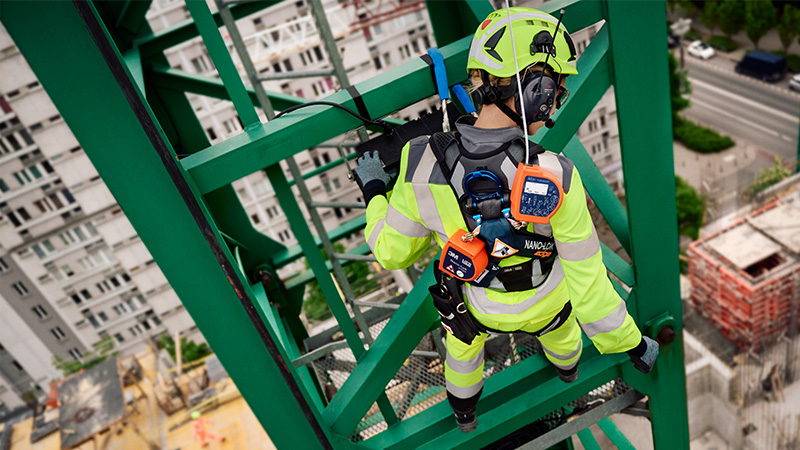
Working at height demands fall protection equipment you can trust without compromise. For the first time in over twenty years, the European standard governing the safety and performance of retractable fall arresters has been revised. EN 360:2002 is being replaced by EN 360:2023, introducing more stringent testing requirements, wider application coverage, and clearer obligations for manufacturers.
So, what does this mean for you as an end user? Will you need to replace your existing retractable fall arresters? Which products are affected by the new requirements? What are the key dates you need to be aware of?
We’ve summarised the essential information for you.
In this article
- What is a retractable type fall arrester and how does it work?
- What does the EN 360 standard entail?
- What is new in EN 360:2023?
- Transitional timeline: key dates
- What about existing retractable fall arresters?
- In summary
1. What is a retractable type fall arrester and how does it work?
A fall arrester — also known as an SRL (Self-Retracting Lifeline) or retractable type fall arrester — is a personal fall protection device that connects a user’s harness to a secure anchor point. It works in much the same way as a car seatbelt: the lifeline extends and retracts smoothly as the user moves, but locks instantly in the event of a sudden fall.
This mechanism makes a fall arrester much easier to use than a traditional lanyard with an energy absorber:
- Maximum freedom of movement: the line automatically follows the user’s movements
- Minimal fall distance: the lanyard remains under constant light tension, arresting a fall within fractions of a second
- Lower deceleration forces: the arrest force on the body is limited to a maximum of 6 kN
- Reduced trip hazards: no loose lanyard hanging near the user’s feet
- Wide range of applications: available in different lengths, materials and housing types to suit a variety of working environments
Some models also incorporate additional features, such as integrated rescue lifting systems - EN 1496 - or automatic descent systems - EN 341. The essential safety and performance requirements for all fall arresters are defined in the EN 360 standard.
2. What is the EN 360 standard?
The EN 360 standard is the European product standard that defines the design, performance and safety requirements for fall arresters. The standard specifies, among other things:
- the maximum arrest force that may be exerted on the user’s body during a fall
- the durability and reliability requirements of the device throughout its service life
- compatibility with full body harnesses certified to EN 361
- the minimum retraction force, required to ensure the lifeline remains permanently tensioned and does not hang loose
Any fall arrester placed on the European market must comply with this standard and be supplied with a valid EU type-examination certificate as proof of conformity.

3. What’s new in EN 360:2023?
The previous version of the standard, EN 360:2002, dated back more than twenty years. Working methods, materials and areas of application have changed considerably since then. The revision introduces stricter and more comprehensive testing requirements.
The standard is called EN 360:2023 because the first draft was drawn up in 2023. Following a harmonisation process, the final version was published in April 2025, with a twelve-month transition period. It has been officially in force since April 2026. The date in the standard's name therefore says nothing about when it takes effect – a common source of confusion that applies to other standards too.
Stricter technical requirements
The new standard introduces higher performance and safety expectations in several key areas, including:
- More rigorous dynamic testing to better garantuee long-term reliability
- Stricter requirements regarding the control of arrest forces during a fall, to further reduce the risk of injury during a fall
- Higher standards for the retraction spring, ensuring the lifeline retracts fully even after intensive, prolonged use
- More extensive testing for use in harsh environments, including exposure to moisture, dust, chemicals and extreme temperatures
Additional application tests are now officially integrated into the standard
One of the most significant changes in EN 360:2023 is the formal integration of application tests that previously existed outside the standard as separate, optional test sheets (PBM R). These tests now officially form part of the standard. This includes testing for:
| Application | Explanation |
|---|---|
|
Horizontal use and sharp edges |
Suitable for applications such as roof work, basement access or working horizontally on structures |
| Users weighing over 100 kg | Explicitly tested and approved for heavier users |
| Fall factor 2 testing | Simulates a worst-case fall scenario in which impact energy reaches its maximum level |
| Use with aerial work platforms (DIN 19427) | Specific requirements and testing for use from work platforms |
Manufacturers can decide which of these additional tests are carried out for a particular model. The results must be clearly indicated on both the product marking and in the user manual. Is a specific application or test not indicated? In which case, that model is not certified for that particular application.
4. Transitional timeline: key dates
The transition from EN 360:2002 to EN 360:2023 is being implemented in phases.
From 9 April 2026
All new models placed on the market must comply with EN 360:2023. However, existing stock produced before this date under a valid EU type-approval certificate may still be sold.
5. What about existing retractable fall arresters?
Existing self-retracting lanyards may continue to be used, sold and produced as long as the EU type-examination certificate for that model remains valid and the date of manufacture is before 8 April 2026. The standard revision does not require anyone to replace or recertify products already in circulation.
There is therefore no reason to take operational self-retracting lanyards out of service simply because EN 360:2023 has come into force.
What if a certificate expires?
The certificate is primarily relevant for manufacturers – not for users or distributors. In practice:
- Stock produced and placed on the market before 8 April 2026 may still be sold and used, even if the certificate subsequently expires.
- Manufacturers may continue producing under EN 360:2002 after 8 April 2026 for as long as their certificate remains valid.
- If a certificate expires after 8 April 2026, recertification can only take place under EN 360:2023.
- New models placed on the market after 8 April 2026 must be certified under EN 360:2023.
6. In summary
| Situation | What are the rules? |
|---|---|
|
Fall arresters in use, certification valid |
Continue using as normal |
| Purchase of a fall arrester; certification valid | May be sold |
| Model certification expires | Manufacturing and sales are no longer permitted |
| New model after 9 April 2026 | Must comply with EN 360:2023 |
Check here to see if your fall arrest block has been certified to the new standards. Can’t find your equipment? Then please contact our experts.