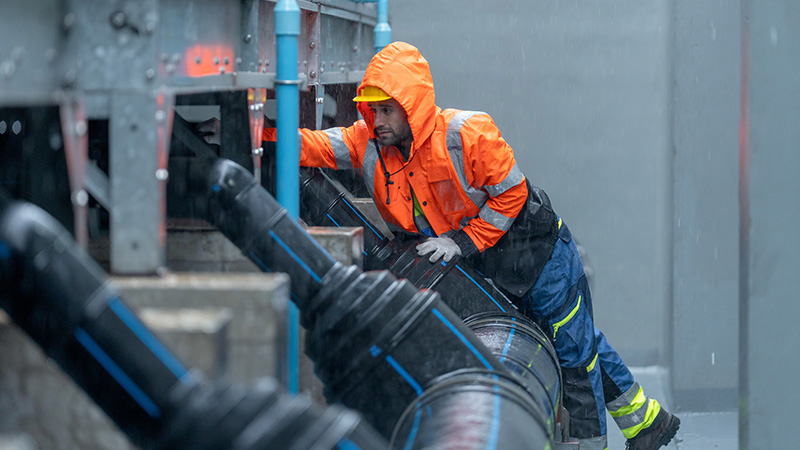
The European standard for protective clothing against rain, EN 343, is being replaced by EN ISO 24232:2025. New testing methods, more stringent material requirements, and global harmonisation—here’s everything you need to know.
Why has the standard changed?
In 2024, the International Organisation for Standardisation (ISO) introduced ISO 24232:2024, which has since been adopted in Europe as EN ISO 24232:2025. This new standard fully replaces the long-standing EN 343, which was previously the benchmark for rainwear performance throughout Europe.
There are two reasons for the change: firstly, the need for international harmonisation (the former EN 343 standard applied exclusively within Europe). and secondly, advances in materials and technology. Modern membranes, laminates, and improved comfort expectations required a more up-to-date and technically robust standard.
The essence of the change in a nutshell
EN ISO 24232:2025 is more technical, more rigorous, and more precisely defined than EN 343. It is now recognised worldwide as the benchmark for protective clothing against precipitation.
The requirements, classification system, and icon remain the same. The icon continues to display values, such as Y = 4, X = 4, and R (x or 3), while terms like Ret and Wp are not shown on the icon. The most visible change is the "name" on the labelling, the certification, and the. DoC (Declaration of Conformity): "EN 343" is replaced by "ISO 24232".
What does the standard cover, and what doesn’t it cover?
One of the most important updates in the new standard is a clearer and more explicit definition of its scope. Where EN 343 offered only limited detail on exclusions, EN ISO 24232:2025 provides a much clearer definition of its scope—explicitly stating what is and is not covered.
| Included | Not included |
|---|---|
|
+ Precipitation (rain and snow) + Fog + Soil moisture |
- Splashes or waves - High-pressure water jets - Gloves - Footwear - Separate head protection |
The two key performance criteria: Wp and Ret
As with EN 343, there are two key performance criteria, but the test methods and definitions have been updated and internationally standardised.
Wp – Water penetration resistance
Resistance to water penetration – Class 1 to Class 4. Class 4 offers the highest level of water penetration resistance. Replaces the former EN 343 WP classification.
Ret – Breathability
Water vapour resistance – Class 1 to Class 4. Class 4 represents the highest level of breathability (lowest Ret value). Replaces the RET classification in EN 343.
Optional
R / X – Garment test
Waterproofness of the finished garment—assessed on the complete, ready-made product using a rain simulator. Performed = R, not performed or not reported = X.
Why is the R-test optional, and when is it relevant?
The garment test evaluates how the complete product. including seams, zips, and fastenings, performs under simulated rainfall. For environments with persistent heavy rainfall or prolonged outdoor exposure, an R-certified garment offers significant added value, even though the test itself is not mandatory.
Classification: how to read a label?
A product certified to EN ISO 24232:2025 includes a label showing its Wp rating, Ret rating and, optionally, the garment test result. Below is the full classification for the two mandatory criteria.
| Class | Wp – water penetration resistance | Ret – Breathability |
|---|---|---|
| 1 | Basic protection | Basic breathability |
| 2 | Average protection | Average breathability |
| 3 | High protection | High breathability |
| 4 | Maximum water penetration resistance | Best breathability |
Case study
A raincoat labelled “Wp 3, Ret 2, R” offers high water penetration resistance, moderate breathability, and has undergone additional testing as a finished garment using a rain simulator.
What are the substantive changes compared to EN 343?
| EN 343 (old) | EN ISO 24232:2025 (new) |
|---|---|
|
A purely European standard A simple structure: Wp, Ret, optional R-test Classes 1–4 for Wp and Ret Limited mechanical requirements Less clearly defined scope R-test optional and limited Based on technology up to 2019 |
International ISO standard, recognised worldwide More comprehensive framework: clear definitions, materials , and garment-level testing Revised Wp/Ret using ISO test methods Mandatory tensile strength + tear resistance Explicit exclusions (waves, footwear...) Revised tests for finished garments (ready-made garments) Designed for modern membranes and laminates |
New mechanical requirements: more sustainable clothing is mandatory
An often underestimated but important addition: EN ISO 24232:2025 introduces, for the first time, mandatory minimum requirements for material quality. Specifically, this refers to minimum requirements for tensile strength and tear resistance of the outer fabric. As a result, garments certified under the new standard are inherently more sustainable than those previously permitted under EN 343.
For buyers, this is a clear advantage: the standard now provides an additional layer of quality assurance, complementing its protective performance criteria.
Transition period and timing
2024: Publication of ISO 24232:2024 as an international standard
2025: Adoption in Europe as EN ISO 24232:2025 – officially replacing EN 343
Now: The transition period is currently underway. Review your current garment certifications and start planning for compliance.
The new icon applies to all new certification applications, and for the renewal of certifications. For items currently in stock that still hold a valid EN 343 certificate, existing markings—such as labels, batch numbers, and the Declaration of Conformity (DoC)—remain valid until a new or renewed certification is required.
Checklist: what should you do now?
- Audit all your current rainwear and verify whether they are certified under EN 343 or EN ISO 24232
- Determine the required Wp and Ret classes for each job and working environment based on your risk assessment.
- Decide whether the optional garment test R is required for your applications
- Confirm whether your suppliers already offer products certified to EN ISO 24232:2025
- Assess the mechanical performance criteria (tensile strength, tear resistance) when making new purchases
- Update your technical data sheets and internal procurement documents to reflect the new standard.
- Inform staff and HR about the updated Wp/Ret classification system.
Want to know if your rainwear complies with EN ISO 24232:2025?
Our experts can carry out a free compliance check of your current protective clothing and advise on the most suitable Wp/Ret classes for your specific sector and working conditions.