Posted on 30 March 2022. Updated on 2 November 2026.
A splash of acid on your hand, or a squirt of lye in your eye: it can happen faster than you think. Chemical burns are caused by the effects of chemicals on the skin and the underlying tissues, including the hypodermis. The chemical substance can even enter the bloodstream. So every second counts.
In this article, you will learn exactly what happens when chemical splashes cause injuries, how to respond correctly, and which rinsing solution is appropriate in each situation.
The short answer: rinse any chemical splashes immediately and thoroughly from the skin or eyes, and remove contaminated clothing, jewellery and contact lenses, provided this can be done safely. Where possible, use a specialised rinsing solution such as Diphoterine®, or in the case of hydrofluoric acid (HF), Hexafluorine®. Do not stop rinsing just because the pain subsides, and always seek medical advice.
What should you do following contact with a chemical substance?
The quicker you respond, the less damage is likely to occur. Ideally, take the following steps immediately:
- Start rinsing as quickly as possible. Do not wait until it hurts or until you are certain which substance is involved.
- Remove any contaminated clothing, shoes, jewellery and contact lenses, provided this can be done safely. This prevents the substance from remaining in contact with your skin through your clothing. Where possible, remove clothing downwards to avoid contaminating your face and eyes again. If necessary, cut open the seams at the shoulders. Never reuse contaminated clothing or contact lenses.
- Rinse for a sufficient amount of time. Do not stop just because the pain subsides: this tells you nothing about how much of the chemical substance may still be present in your tissue. Use the entire contents of the rinsing solution in accordance with the instructions for use.
- Seek medical advice. After rinsing, it is best to have the injury assessed by a doctor, particularly in cases involving concentrated chemicals or eye exposure.
No rinsing solution available? Do not wait: rinse immediately and thoroughly with water, preferably lukewarm water. Rinsing with water is always better than waiting for the correct solution.
What are chemical burns (chemical injuries)?
We distinguish between two categories of chemical substances that can cause injury through direct contact:
- Corrosive substances can cause severe and irreversible tissue damage.
- Irritant substances generally cause redness, irritation or inflammation.
Depending on the concentration and the circumstances, the same substance may be either corrosive or irritating. That is why any contact with an aggressive chemical should be treated as an emergency.
Six types of aggressive chemical reactions
- Acid reaction: H⁺
- Alkaline reaction: OH⁻
- Oxidation reaction: transfer of electrons (E⁻)
- Reduction reaction: transfer of electrons (E⁻)
- Chelating reaction: Ca⁺⁺
- Dissolution reaction: for example, acetone or ethanol
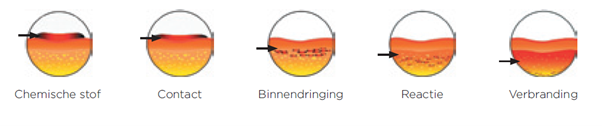
Three stages common to all chemical burns
- The chemical substance comes into contact with your skin or eyes.
- The substance penetrates the underlying skin layers and tissues. The injury starts immediately and becomes more severe over time. The damage does not become irreversible immediately, but the window of opportunity for intervention closes rapidly.
- A reaction takes place in which cells are damaged.
What determines how quickly and how deeply the substance penetrates?
- The type of product and its concentration.
- The temperature of the chemical substance.
- The duration of exposure.
Simply removing the substance from the surface is therefore not enough. You also need to deal with any substance that has already penetrated the tissue.
Water: effective, but often not enough
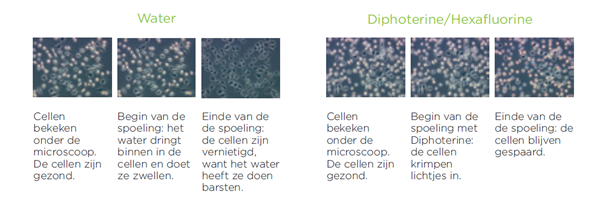
Rinsing with water has long been the standard method, and rightly so: water is widely available, easy to use and non-toxic. It dilutes the chemical substance, removes some of the contamination from the surface and washes the substance away from the skin.
Water removes the substance from the surface, but does not remove chemicals that have already penetrated the tissue.
However, water also has its limitations:
- It does not directly neutralise the aggressive properties of the chemical substance.
- It has little effect on substances that have already penetrated the tissue.
- It can even promote the penetration of certain chemicals.
- When dealing with concentrated substances that penetrate extremely quickly, water often comes too late.
Still need to rinse with water? If so, use lukewarm water wherever possible to reduce the risk of hypothermia and shock.
Diphoterine®: rinse and treat
Diphoterine® is a sterile, phosphate-free rinsing solution classified as a Class IIa medical device. It can also be used on damaged skin. It does more than simply rinse: it also acts on the injury process itself. It achieves this through four properties:
- Mechanical rinsing: The liquid washes the chemical substance away from the skin or eye.
- Hypertonic: The solution has a higher osmotic pressure than blood and tears. This helps draw substances that have already penetrated the tissue, back towards the surface and limits further penetration.
- Amphoteric: The solution reacts with both acidic and alkaline substances.
- Chelating: the solution binds certain chemical molecules and ions, making them less aggressive.
Diphoterine® can be used for a wide range of substances including acids, alkalis, oxidising agents, reducing agents, chelating agents, solvents and alkylating agents. By stopping or limiting the reaction between the chemical substance and your tissue, it can reduce the severity of the injury.
In 2026, Diphoterine® was recertified as a Class IIa medical device. The assessment confirms that it is more effective than water in preventing or reducing the severity of injuries, including when rinsing is delayed. According to preclinical data, it helps restore the pH to a range of 5.5–9.0. Find out more in our article: Diphoterine® Recertified: What do clinical trials say about water?
One exception: hydrofluoric acid (HF)
Hydrofluoric acid is one of the most dangerous chemicals to human health. It is not only corrosive but also toxic: fluoride ions penetrate deep into the tissue. Pain often only develops later, even though the damage is already taking place. An HF splash can therefore sometimes appear harmless, but it is not.
Diphoterine® has only limited effectiveness against HF. For HF and its derivatives, use Hexafluorine®: a rinsing solution that binds both hydrogen ions (H⁺) and fluoride ions (F⁻). Always seek medical assistance following exposure to HF.
The right format in the right place
Diphoterine® is available in various formats, ensuring that an appropriate solution is always within easy reach.
|
Format |
Suitable for |
Rinsing time |
|
Portable eye wash (50 ml) |
One eye; carry it with you |
10 seconds. |
|
Eye wash (500 ml) |
More thorough rinsing of one eye |
1 minute |
|
Spray (100 ml) |
Hands or small areas |
1 minute |
|
Spray (200 ml) |
Face and arms |
1 minute |
|
Portable body shower (5 l) |
Large area of skin or the entire body |
1 minute |
|
Wall-mounted holder or mobile station |
Fixed or changing workplaces |
Combination of the above |
Prévor products have a shelf life of two years and are intended for single use. Vandeputte offers a trade-in programme where they can be replaced with new products every two years.
The most suitable format depends on the substance involved, the potential area of exposure and the distance from the hazard. Would you like to know how to choose the right format and where to position your rinsing facilities? Read our article: Chemical burns: When water comes too late.
What you need to know
- Act immediately: The quicker you start rinsing, the less damage is likely to occur.
- Remove any contaminated clothing, shoes, jewellery and contact lenses, provided this can be done safely.
- Water dilutes chemicals, but is often too slow when dealing with concentrated substances.
- Diphoterine® rinses and helps limit the penetration and aggressive effects of the chemical substance.
- Use Hexafluorine® for hydrofluoric acid (HF).
- Do not stop rinsing just because the pain subsides, and always seek medical advice.
Frequently asked questions about chemical burns
Should you use water for chemical burns?
If nothing else is available, rinse immediately with water. A specialised solution also removes substances from the tissue.
What is the difference between chemical and thermal burns?
Thermal burns are caused by contact with extreme heat, such as hot steam or welding spatter. Chemical burns are caused by chemicals that also damage deeper tissues and can enter the bloodstream. For thermal burns, rinse for an extended period with lukewarm running water. For chemical burns, water is often not enough.
What should you do if a chemical substance splashes into your eye?
Rinse the eye immediately and remove contact lenses, provided this can be done safely. Use Diphoterine®: the 50 ml personal eye wash within 10 seconds, or a 500 ml eye wash within 1 minute. Always have the injury assessed by a medical professional afterwards.
What should you do if acid or lye (caustic alkali) comes into contact with your skin?
Remove contaminated clothing, shoes and jewellery, and rinse the skin immediately. Use the Diphoterine® spray for hands and small areas, or for the face and arms. For larger areas, use the portable body shower. Consult a doctor immediately afterwards.
When should you see a doctor?
After a chemical splash, it is always best to have the injury assessed by a medical professional, particularly when the eyes are involved, or when exposure involves concentrated or corrosive substances or hydrofluoric acid (HF). With HF, the damage may only become apparent later on.
Try it out for yourself
During our workshops, you will learn how to respond appropriately to chemical burns and chemical spills, using the right equipment. Explore our training courses or sign up now.
Interested in a risk assessment or advice on the correct positioning of rinsing solutions? Vandeputte is happy to help you find the right solution.